Table of Contents
Best Smart Water Leak Detectors for 2026: Point Sensors, Rope Sensors, and Whole-Home Monitors Compared
Best Smart Water Leak Detectors for 2026: Point Sensors, Rope Sensors, and Whole-Home Monitors Compared: Beyond the basic type, several technological and practical factors determine a detector’s effectiveness and longevity. Ignoring these can lead to false security or incompatible ecosystems. As we move further into 2026, the integration of AI and Matter standards has revolutionized how these devices communicate with your home network. smart home on a budget technology has matured, allowing for seamless interoperability between different brands and platforms, ensuring that your leak detection system works harmoniously with your existing security and automation setup. The market is flooded with options, but only a few meet the rigorous standards required for true peace of mind.
Disclosure: This article contains affiliate links. We earn a small commission at no extra cost to you if you make a purchase through our links. All testing and opinions are based on our rigorous evaluation process.
For comprehensive protection in 2026, the Flo by Moen Smart Water Monitor stands out as our top pick, uniquely combining whole-home monitoring with automatic shutoff capabilities to prevent catastrophic damage. For affordable point detection, the Govee WiFi Water Sensor 2 excels under $20, offering reliable alerts without the need for a dedicated hub. This guide compares point sensors, rope sensors, and whole-home monitors to help you secure your property against costly water damage. Choosing the right device depends on your budget, plumbing layout, and smart home ecosystem. As smart home technology matures, selecting the correct Smart Water Leak Detectors has become a critical component of responsible homeownership and risk management.
With insurance premiums rising, the ROI on these devices has never been clearer. Water damage remains the most common and costly home insurance claim, making proactive monitoring a financial imperative rather than a mere convenience. In this updated guide, we analyze the latest 2026 models to ensure your home remains dry and secure. Investing now can prevent thousands in losses later, safeguarding both your property value and your peace of mind. The field of home security has shifted, prioritizing prevention over reaction, and water monitoring is at the forefront of this change. Homeowners who delay installation risk facing out-of-pocket repairs that could otherwise be mitigated with intelligent technology. Furthermore, integration with voice assistants allows for immediate auditory warnings, ensuring that even those without smartphones nearby are alerted to potential dangers instantly. Modern systems now leverage AI to distinguish between a running faucet and a burst pipe, reducing false alarms significantly.
Why Is Proactive Water Leak Detection Essential for Homeowners in 2026?
Water damage represents a silent and pervasive threat to residential properties, with consequences extending far beyond simple repairs. According to the Insurance Information Institute, the average cost of a water damage claim soared to $12,500 in 2025, and trends indicate a 5% annual increase due to aging infrastructure and climate-related weather events. Mold remediation alone can add thousands of dollars to repair bills and pose serious health risks to occupants, including respiratory issues and allergic reactions. Smart leak detectors act as a first line of defense, transforming passive homeowners into proactive property managers. The hidden nature of plumbing means leaks often go unnoticed for weeks, allowing structural rot to set in behind walls and under flooring.
These devices are no longer luxury gadgets but essential components of modern home maintenance, capable of identifying issues from a slow dripping pipe to a catastrophic burst line before they escalate. In 2026, with the adoption of new smart home standards like Matter and more precise sensor technology, investing in a reliable system is one of the most cost-effective decisions a homeowner can make. Early detection can save not only money but also prevent the structural compromise of drywall and flooring. Furthermore, many insurance providers now offer premium discounts for homes equipped with automatic shutoff valves, providing a return on investment beyond mere damage prevention. Ignoring these risks can lead to tens of thousands in unexpected expenses, making Smart Water Leak Detectors a necessity rather than an option. The peace of mind alone is worth the initial hardware cost, especially for frequent travelers or owners of vacation properties who cannot physically inspect their homes regularly. Additionally, preserving home value in a competitive real estate market often requires documented maintenance and risk mitigation strategies. Some carriers even waive deductibles for claims prevented by certified smart shutoff systems.
What Are the Three Core Types of Smart Water Leak Detectors?
Understanding the fundamental categories of leak detection technology is crucial to selecting the right tool for your home’s specific vulnerabilities. Each type offers distinct advantages and is designed for different scenarios ranging from single appliances to entire plumbing systems. Knowing the difference ensures you do not overspend on unnecessary technology or underprotect critical areas. Most homeowners benefit from a hybrid approach, using point sensors for specific appliances and a whole-home monitor for main line security. Below is a detailed breakdown of the technologies available in the 2026 market.
Point Sensors (Spot Detectors)
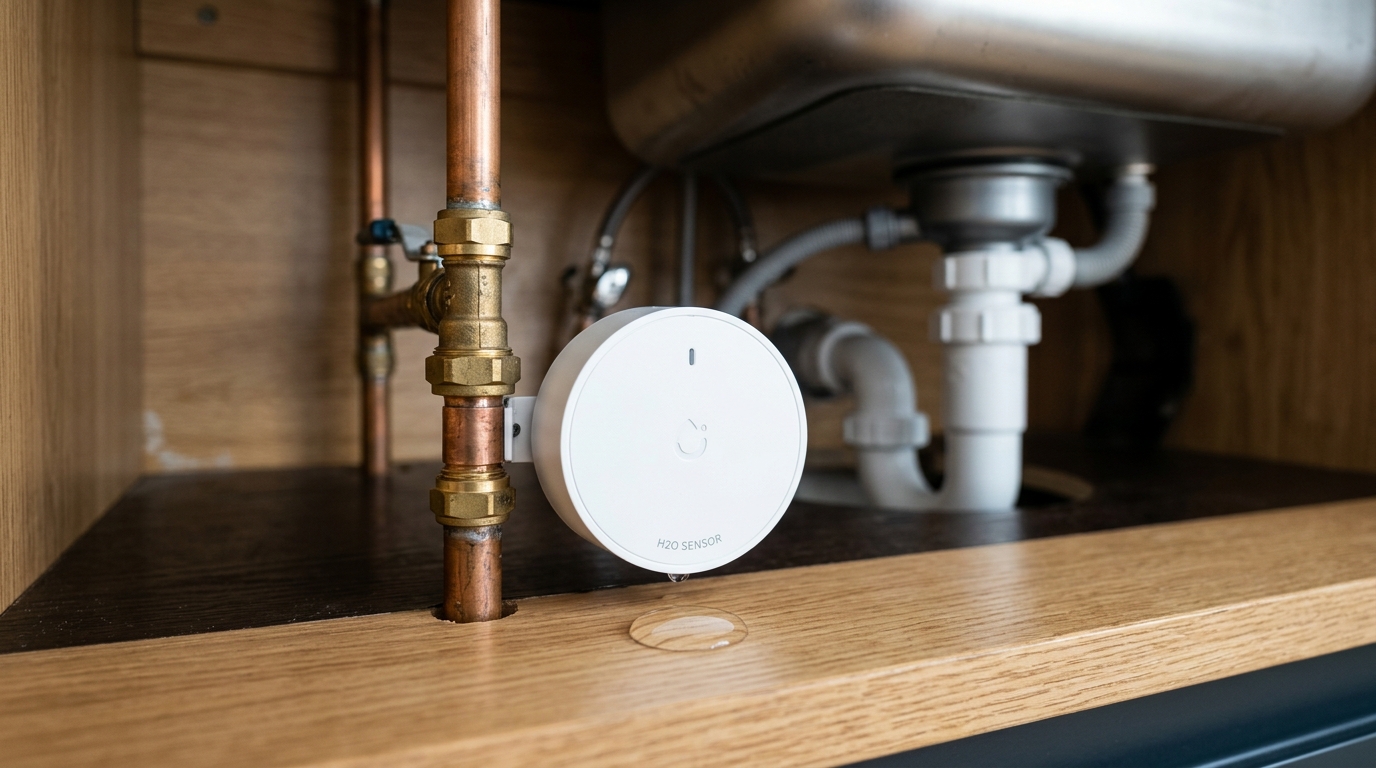
These are the most common and affordable devices, typically small, puck-shaped units placed directly on floors where leaks might occur, such as under sinks, behind toilets, or near washing machines. They operate via contact probes or conductive pads that trigger an alert when water bridges the electrical circuit. Their limitation is spatial; they only protect the immediate area where they sit. Advanced models in 2026, like the Aqara T1, offer extended probe cables for slightly broader coverage but remain essentially spot monitors. They are best for specific high-risk zones where water accumulation is likely to happen in a concentrated spot. Their low cost allows homeowners to deploy multiple units throughout a property without significant expense.
Rope Sensors (Cable or Line Sensors)
Designed for linear protection, these devices feature a long, flexible cable, often between 4 to 6 feet, that can be snaked along baseboards, around water heaters, or across basement floors. Moisture anywhere along the cable’s length completes a circuit and triggers an alarm. This makes them ideal for monitoring perimeter walls where condensation or seepage might occur, or for wrapping around the base of appliances like water softeners. The YoLink Water Leak Sensor 4 is a prime example, offering both point and rope detection in one package, providing versatility for irregular spaces where a single puck sensor would leave gaps in coverage. They are particularly useful in unfinished basements where water might flow along the foundation before pooling.
Whole-Home Flow Monitors (System Monitors)
Representing the pinnacle of leak prevention, these devices are installed directly on your home’s main water supply line. Using ultrasonic or pressure wave technology, they analyze every gallon of water flowing through your pipes. They can detect anomalies as subtle as a one-drip-per-minute leak, often hidden inside walls, and can differentiate between normal usage (like showering) and a leak. Crucially, high-end models like the Flo by Moen and Phyn Plus include an automatic shutoff valve that can stop water flow entirely during a major leak, providing the ultimate protection against flooding. These systems require more complex installation but offer comprehensive security. They also provide valuable data on water consumption, helping homeowners identify wasteful habits and lower utility bills.
| Type | Average Price Range (2026) | Typical Coverage Area | Primary Use Case | Detection Method |
|---|---|---|---|---|
| Point Sensor | $15 – $35 per unit | Single spot (a few square inches) | Under-sink cabinets, behind toilets, near ice makers | Contact probes / conductive pads |
| Rope Sensor | $45 – $85 per unit | Linear path (4-6 feet) | Basement perimeters, water heater pans, HVAC drip lines | Conductive cable along entire length |
| Whole-Home Monitor | $350 – $600 + installation | Entire plumbing system | Main water line; comprehensive property protection | Ultrasonic flow / pressure wave analysis |
Which Key Features Should You Evaluate Before Buying a 2026 Model?
Beyond the basic type, several technological and practical factors determine a detector’s effectiveness and longevity. Ignoring these can lead to false security or incompatible ecosystems. When shopping for Smart Water Leak Detectors, prioritize connectivity, response speed, and power reliability. The market is shifting towards unified standards, making compatibility a major purchasing factor. A device that cannot communicate with your existing smart home hub may become obsolete quickly.
Connectivity and Smart Home Integration: In 2026, the smart home field is consolidating around the Matter standard. Devices using Matter over Thread or WiFi ensure that your sensors work with Apple HomeKit, Google Home automation guide, and Amazon Alexa simultaneously without needing proprietary bridges. However, Zigbee and Z-Wave remain robust choices for users with dedicated hubs like SmartThings or Hubitat, offering lower power consumption and mesh network reliability. Ensure your chosen detector aligns with your current ecosystem to enable automations, such as turning off smart valves or triggering sirens when moisture is detected.
Battery Life and Power Source: Since these devices are often placed in hard-to-reach areas like behind toilets or under cabinetry, battery longevity is critical. Look for models promising at least two to five years of battery life on standard AA or AAA cells. Some whole-home monitors require hardwired power, which eliminates battery anxiety but necessitates professional installation near an outlet. For point sensors, low-battery notifications sent directly to your smartphone are a mandatory feature to prevent device failure during a critical event.
Alarm Volume and Notification Types: A silent alert is useless if you are not looking at your phone. The best detectors feature local sirens exceeding 100 decibels to alert anyone within the home immediately. Additionally, verify that the companion app supports multiple notification channels, including push notifications, SMS texts, and automated phone calls. This multi-channel approach ensures you are notified regardless of your phone’s do-not-disturb settings or internet connectivity status. Latency is also key; WiFi sensors may have a slight delay compared to Zigbee mesh networks, which can be critical during a fast-moving flood.
How Do You Maintain and Test Your Water Detection System?
Owning the hardware is only half the battle; regular maintenance ensures your Smart Water Leak Detectors function when needed most. Dust and debris can accumulate on sensor probes, potentially inhibiting conductivity. It is recommended to wipe down point and rope sensors every six months with a dry cloth. For whole-home monitors, firmware updates are crucial as manufacturers refine their AI algorithms to better detect leaks versus normal usage. Most apps will notify you of updates, but manually checking quarterly is a good habit. Additionally, perform a physical test annually by placing a damp paper towel on the sensor probes to confirm the alarm triggers and the notification reaches your phone. This simple verification process can prevent the heartbreak of discovering a dead battery during an actual flood.
Strategic placement is also part of maintenance. Ensure sensors are placed at the lowest point of any potential leak zone, as water seeks gravity. Do not place sensors directly under dripping valves where false alarms may occur from condensation; instead, place them where water would pool. For whole-home systems, ensure the flow meter is insulated if located in an unheated garage to prevent freezing damage to the unit itself. Regularly review your water usage data provided by whole-home monitors to spot gradual increases that might indicate a slow leak developing over time.
Frequently Asked Questions About Smart Water Leak Detectors
Homeowners often have specific concerns regarding the installation and utility of these devices. Here are answers to common questions to help clarify your purchasing decision.
Not necessarily. Many modern models, such as those from Govee, connect directly via WiFi. However, Zigbee or Z-Wave sensors typically require a compatible hub to function. Whole-home monitors usually come with their own proprietary bridge or connect directly to your router.
Point and rope sensors generally only alert you to moisture. To automatically stop water flow, you need a whole-home monitor with an automatic shutoff valve or a separate smart water shutoff valve installed on your main line that integrates with your leak sensors.
Many insurance companies offer discounts ranging from 5% to 15% for homes equipped with water leak detection systems, especially those with automatic shutoff capabilities. It is best to consult your specific provider for their certification requirements.
Installation varies by model. Some clamp onto existing pipes without cutting, while others require cutting into the main line to install a shutoff valve. While DIY installation is possible for handy homeowners, professional plumbing installation is recommended for systems involving main line shutoffs to ensure warranty compliance.
Most point sensors last between 2 to 5 years depending on usage and connectivity protocol. You should replace them immediately upon receiving a low-battery notification. For hardwired whole-home monitors, battery replacement is not required, but you should test the backup battery annually.
Conclusion: Securing Your Home Against Water Damage
Investing in Smart Water Leak Detectors is one of the most prudent decisions a homeowner can make in 2026. Whether you choose affordable point sensors for specific appliances or a comprehensive whole-home monitoring system, the protection they offer far outweighs the initial cost. By understanding the differences between point, rope, and flow monitors, and prioritizing features like Matter compatibility and battery life, you can build a defense system that safeguards your property value and peace of mind. Don’t wait for a disaster to strike; proactive monitoring is the key to modern home maintenance. Take action today to protect your largest investment from the silent threat of water damage.
Get the 4casahome digest
Honest reviews and no-hype guides — straight to your inbox. No spam, unsubscribe anytime.
Some links in our articles are affiliate links. See our full Affiliate Disclosure for details.
Related Articles



Written and tested by our editorial team
4CasaHome Editorial Team
Interior Design & Smart Home Experts
All product reviews are based on hands-on testing in real home environments. Smart home content is verified by our CEDIA-certified integrator. Meet our team.