
Table of Contents
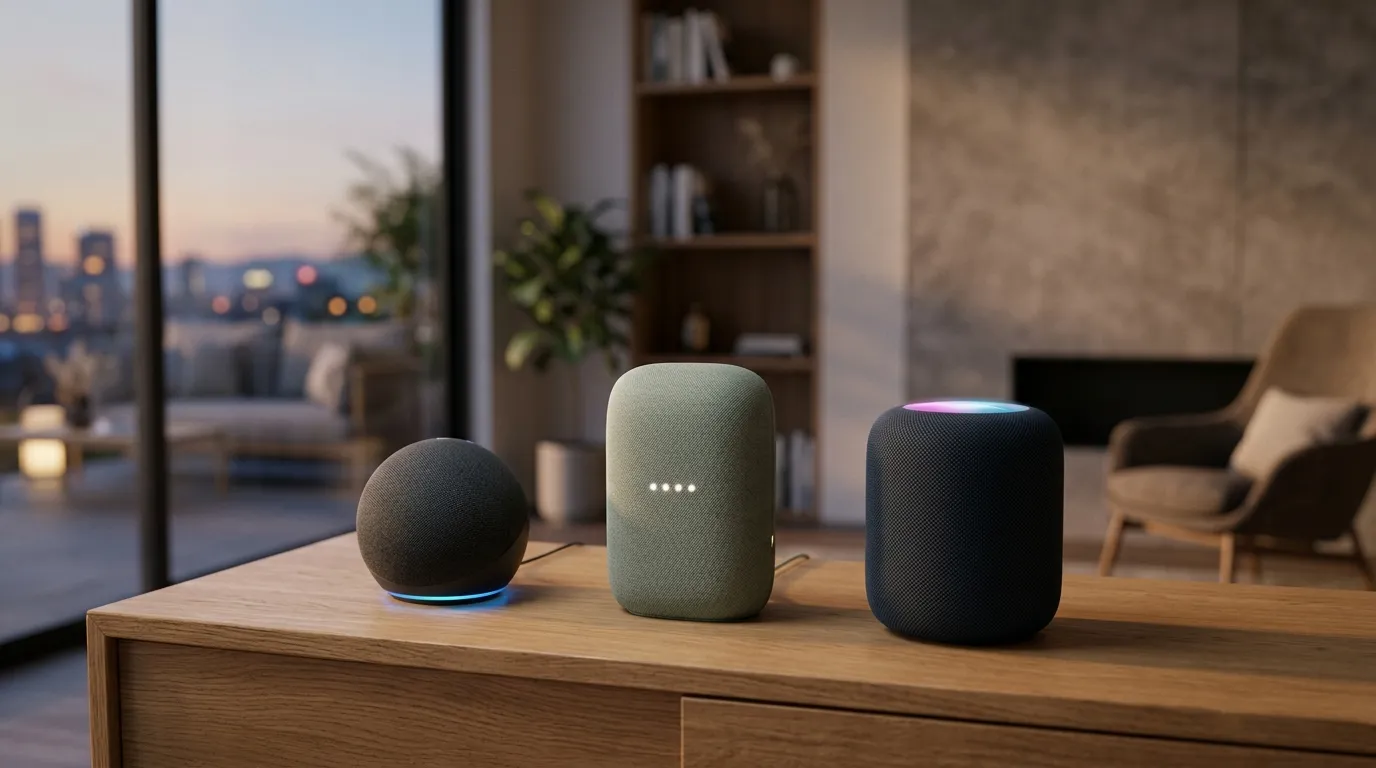
Choosing between Amazon Echo, Google Nest, and Apple HomePod depends on your existing tech ecosystem, audio priorities, and privacy. Apple HomePod excels for iPhone households, Google Nest for Android and Google services, and Amazon Echo for broad smart home on a budget control. Your primary smartphone platform is the most critical deciding factor.
Why Should Your Digital Ecosystem Be the Deciding Factor in Your Smart Speaker Choice?
Your smart speaker should seamlessly integrate with the devices and services you use daily, rather than creating friction. A 2024 consumer survey by Parks Associates found that 68% of smart speaker owners reported highest satisfaction when their speaker matched their primary smartphone OS. This alignment unlocks features like effortless handoff, synchronized calendars, shared reminders, and unified smart home controls that define a cohesive experience. Investing in a speaker from a different ecosystem often leads to clunky workarounds, reduced functionality, and daily frustrations. For instance, using an Apple HomePod with an Android phone means losing the ability to send iMessages, use Personal Requests, or seamlessly transfer music via Handoff. Your decision is not just about a speaker; it’s about choosing a platform that amplifies your existing digital life.
Apple HomePod: The Unquestioned Hub for the All-Apple Household
If your life is built around iPhone, Mac, iPad, and Apple Watch, the HomePod (2nd Gen) or HomePod mini is the natural, powerful centerpiece. It acts as a native command center for Apple’s tightly integrated ecosystem. Features like Handoff let you transfer music, podcasts, or phone calls to the HomePod by simply bringing your iPhone close. Siri can add items to shared Apple Reminders lists, send iMessages, or display live feeds from HomeKit Secure Video cameras on your Apple TV with a voice command. It has deep, preferential access to Apple Music, including Lossless and Spatial Audio tracks. For families, capabilities like Intercom and voice recognition for up to six users work flawlessly. However, integrating third-party services like Spotify or YouTube Music requires using AirPlay, which lacks the deep voice control and automation of native Apple services.
Google Nest: The Intelligent Assistant for Android and Google Service Users
For individuals and families invested in the Google universe—using Android phones, Gmail, Google Calendar, YouTube Premium, and Google Photos—Nest speakers (Nest Audio, Nest Mini) offer a profoundly connected and proactive experience. The Google Home automation guide app serves as a unified control panel on your Android device. You can ask your Nest speaker about your next meeting from Calendar, view a slideshow of recent Google Photos on a Nest Hub display, or get traffic alerts based on your commute in Google Maps. Chromecast built-in allows effortless casting from thousands of apps. Google’s ecosystem is notably welcoming to multi-platform users, with robust iOS app support and broad third-party music service integration, making it a versatile choice for mixed-device households.
Amazon Echo: The Flexible, Agnostic Hub for Cross-Platform Smart Homes
The Amazon Echo platform is engineered for maximum compatibility and flexibility, designed to bridge various devices and services without requiring a specific smartphone OS. The Alexa app functions nearly identically on iOS and Android. This makes Echo a top choice for households with mixed devices or users loyal to Amazon’s services like Prime, Music Unlimited, or Audible. Its core strength is connecting a vast array of smart home gadgets from different brands into a coherent, voice-controlled system. With support for over 310,000 smart home devices as of 2024, it leads in breadth. For users prioritizing smart home control over deep personal service integration, Echo is often the most pragmatic and versatile path.
Audio Quality Showdown: Which Smart Speaker Delivers the Best Sound Experience?
Audio fidelity is a major differentiator, with each manufacturer applying distinct engineering philosophies. Objective data from authoritative testing labs like RTINGS.com and SoundGuys, combined with subjective evaluations, reveals clear acoustic profiles suited for different primary uses. The “best” sound depends on whether you prioritize critical music listening, immersive home theater, balanced multi-room audio, or budget-friendly performance.
Apple HomePod (2nd Generation): The Audiophile Benchmark
Launched in January 2023, the second-generation HomePod is widely regarded as the acoustic gold standard for standalone smart speakers. It incorporates a custom high-excursion woofer, five beamforming tweeters, and an Apple S7 chip that performs real-time computational audio analysis. This system measures room acoustics 180 times per second, dynamically adjusting output. It fully supports Dolby Atmos spatial audio with Apple Music, creating a remarkably wide and precise soundstage. Independent tests show a frequency response from approximately 28Hz to 20kHz with exceptionally low distortion. For discerning listeners, a stereo pair of HomePods connected to an Apple TV 4K offers an unmatched wireless high-fidelity home theater solution, rivaling dedicated soundbars.
Amazon Echo Studio: The Cinematic Powerhouse and Value Leader
Priced at $199.99, the Echo Studio delivers a cinematic, room-filling audio experience that challenges speakers costing significantly more. Its five-driver array includes a 5.25-inch downward-firing woofer for bass extension down to 30Hz, three 2-inch mid-range drivers, and a 1-inch front-firing tweeter. It natively decodes 3D audio formats like Dolby Atmos and Sony 360 Reality Audio through Amazon Music Unlimited. A standout feature is dedicated home theater integration: when paired with a Fire TV device like the Fire TV Stick 4K Max, two Echo Studios can act as wireless front left and right channels for a true 3.1.2 or 5.1.2 Dolby Atmos setup. While its mid-range clarity for vocals may not match the HomePod’s nuance, its dynamic power, impactful bass, and immersive spatial effects for movies and gaming represent exceptional value.
Google Nest Audio and Speaker Groups: The Champion of Multi-Room Harmony
Google’s acoustic approach prioritizes balanced, clear sound and flawless multi-room synchronization. The Nest Audio ($99.99) uses a 75mm mid-woofer and a 19mm tweeter, enhanced by “Media EQ” machine learning that adjusts sound profiles based on content type—music, podcast, or audiobook. It excels at vocal clarity and consistent listening at various volumes. Google’s true strength is its Chromecast built-in protocol. Creating a speaker group across multiple Nest devices, third-party Chromecast-enabled speakers, and TVs is incredibly reliable, with near-perfect lip-sync for video and seamless audio handoff between rooms. This makes the Google ecosystem ideal for users who want whole-home synchronized sound from services like Spotify, YouTube Music, and Pandora.
Budget and Mid-Range Audio: A Clear Hierarchy Emerges
In the affordable segment, audio quality diverges noticeably. The Apple HomePod mini ($99) uses computational audio to produce a full, spacious sound from its 3.3-inch driver, focusing on balanced tonality over raw power. The 4th-generation Amazon Echo ($99.99) offers satisfying 360-degree audio from its front-firing tweeter and rear-facing woofer. The Google Nest Mini ($49.99) provides clear voice reproduction and adequate music for small spaces. For background listening and core assistant functions, all are competent. However, for dedicated music enjoyment in a primary living space, investing in the higher-tier models—HomePod (2nd Gen), Echo Studio, or Nest Audio—yields a substantial and immediately apparent auditory improvement.
Voice Assistant Intelligence: Which AI is Smarter for Everyday Tasks and Complex Queries?
The utility of a smart speaker hinges on the intelligence of its voice assistant, measured by accuracy, contextual understanding, and proactive helpfulness. Annual independent evaluations, such as those by Loup Ventures, provide benchmarks, while the integration of generative AI large language models in 2024 is qualitatively transforming capabilities. Each assistant reflects its parent company’s core competencies.
Google Assistant: The Knowledge and Context Leader Powered by Gemini
Leveraging the world’s most comprehensive search index and the advanced Gemini large language model, Google Assistant remains the most knowledgeable and conversational assistant available. In Loup Ventures’ 2023 test of 800 common queries, Google Assistant correctly answered 93.2% of questions, outperforming rivals. It excels at natural follow-up questions, maintaining context across interactions. Its deep integration with personal Google services allows for proactive, personalized alerts about flight delays, traffic, or package tracking from Gmail. The 2024 rollout of Gemini enables advanced generative tasks like summarizing articles, drafting shopping lists, or planning trips. For open-ended questions and complex information retrieval, it is currently unparalleled.
Amazon Alexa: The Automation Powerhouse with a Vast Skill Library
Alexa’s dominance lies in smart home command and routine automation. Its compatibility with over 310,000 smart home devices is the industry’s broadest, according to Amazon’s 2024 data. Alexa Routines can trigger intricate sequences involving dozens of actions across different brands based on voice commands, schedules, or sensor triggers. Features like “Hunches” learn from behavior and proactively suggest automations. For general knowledge, Alexa has relied on Bing, but Amazon is enhancing this with its own large language model for more conversational responses. The Alexa Skills store offers over 200,000 third-party voice apps. Its core value is transforming your home into a responsive, automated environment.
Apple Siri: The Privacy-Focused Concierge for Apple Ecosystem Tasks
Siri is optimized for privacy, speed, and performing tasks within Apple’s integrated ecosystem. It handles personal commands like sending messages, adding to shared lists, or playing music with high reliability and on-device processing where possible. With iOS 17 and later, more Siri processing occurs directly on the device, making requests faster and keeping data private. Apple reports Siri handles over 25 billion requests monthly worldwide. However, for broad web queries or complex conversations, Siri can be less flexible and often requires specific phrasing. For Apple users, it serves as a trustworthy, efficient personal assistant for family coordination and device control, trading off some breadth for enhanced privacy and ecosystem harmony.
Smart Home Hub Capabilities: Which Platform is the Most Powerful and Future-Proof?
The hub capabilities embedded in your speaker determine your smart home’s reliability, compatibility, and automation sophistication. The introduction of the Matter 1.2 smart home standard in late 2023 is a pivotal shift toward interoperability, but implementation and supporting wireless protocols like Thread and Zigbee create critical differences in performance, security, and long-term viability.
Amazon Echo: The Universal Translator with Maximum Device Compatibility
Amazon’s Echo devices, particularly the 4th-gen Echo and Echo Studio, offer the most comprehensive hub hardware in a consumer speaker. They include a built-in Zigbee radio, allowing direct, local connection to thousands of Zigbee-based sensors, bulbs, and locks without a separate bridge. They also support Wi-Fi, Bluetooth LE, Matter-over-Wi-Fi, and Thread. The Alexa app provides a powerful interface for managing this extensive device library. Alexa Routines offer unparalleled depth with support for multiple triggers, conditions, and actions, enabling sophisticated cross-brand automations. Its support for local control of Zigbee and Matter devices ensures key automations function even during internet outages.
Apple HomePod: The Secure, Local Processing Hub with Strong Thread Support
Every HomePod and HomePod mini functions as a full-fledged HomeKit hub. Apple’s architecture emphasizes local processing, speed, and privacy. Most automations run directly on the HomePod hardware, yielding near-instantaneous response times and continued operation if Wi-Fi fails. The Apple Home app is consistently praised for its clean, intuitive, and privacy-focused interface. Crucially, the HomePod mini contains a Thread border router, creating a robust, low-power, self-healing mesh network for Matter-over-Thread devices. HomeKit Secure Video processes camera footage locally on the hub before sending only encrypted, event-based clips to iCloud. This combination makes HomePod a supremely secure and responsive hub for Apple-centric homes.
Google Nest: The User-Friendly Visual Command Center with Growing Thread Adoption
Google Nest prioritizes simplicity, visual feedback, and seamless integration with Google’s services. The Nest Hub (2nd Gen) and Nest Hub Max provide a tactile touchscreen dashboard to control devices, view camera feeds, and get visual answers. The Google Home app is streamlined for easy device setup and routine creation. However, most Nest speakers lack built-in Zigbee radios, often requiring manufacturer-specific hubs for Zigbee products. Newer devices like the Nest Hub (2nd Gen) and Nest Wifi Pro include Thread radios for Matter support. Google’s automations (called “Routines”) are easier for beginners but offer less conditional complexity than Alexa’s. For users wanting a clear, visual interface and deep integration with Google’s awareness of schedule and location, Nest provides a cohesive and approachable smart home starting point.
Privacy and Data Security: How Do Each Brand’s Policies Actually Protect You?
Data handling practices are intrinsically linked to each company’s core business model: Amazon’s retail, Google’s advertising, and Apple’s hardware sales. These models dictate default privacy settings, data retention policies, and user control, impacting how voice interactions are stored, analyzed, and used.
Apple HomePod: Privacy Engineered into the Core Architecture
Apple’s hardware-centric business model allows it to design privacy as a default feature. By default, Siri requests are associated with a random, rotating identifier, not linked to your Apple ID. Audio recordings are not stored on Apple servers in a personally identifiable form, and users can opt to have no audio saved. A significant portion of processing happens directly on the HomePod’s S7 chip. All HomeKit data, including accessory status and HomeKit Secure Video, is protected by end-to-end encryption that Apple cannot decrypt. According to Apple’s transparency reports, while the company complies with valid legal requests for data, these typically pertain to iCloud account information, not Siri voice data from HomePods, due to its anonymized storage.
Google Nest: Personalized Assistance with Configurable Data Controls
Google’s advertising-supported model utilizes data to personalize and improve your Assistant experience. Users have granular controls via the “My Activity” dashboard, where they can set voice and audio history to auto-delete after 3, 18, or 36 months, or disable storage entirely. “Guest Mode” on Nest smart displays temporarily pauses personalization and prevents activity saving. Google states that voice data may be used to improve services and inform advertising trends, but it is anonymized and aggregated before use. In 2024, over 85% of Assistant audio processing for common commands occurs on-device, reducing raw audio data sent to servers. Google also provides a clear, five-year minimum software update promise for its Nest devices.
Amazon Echo: Commerce-Informed Data with Comprehensive User Management Tools
Amazon utilizes voice data to refine Alexa’s accuracy and to inform product recommendations across its retail platform. All Echo devices feature a physical microphone mute switch that electronically disconnects the mics. Through the Alexa Privacy hub, users can review and delete voice recordings, create voice profiles, and opt out of using recordings for feature development. Amazon has increased on-device processing for wake-word detection and simple commands. While not as restrictive as Apple’s defaults, Amazon provides configurable privacy tools. Achieving high privacy with an Echo requires proactive management of these settings, reflecting Amazon’s balance between customer trust and data utility for its shopping and services business.
Long-Term Value: Assessing Total Cost of Ownership and Ecosystem Lock-In
The initial purchase price is merely the entry point. True total cost of ownership encompasses required subscriptions, compatible device expenses, and the potential cost of ecosystem lock-in over time. Long-term value is defined by software support longevity, adaptability to new standards like Matter, and how well the system scales over 5 to 7 years.
Subscription Services: The Ongoing Financial Commitment
Each ecosystem encourages enrollment in paid services for optimal experience. For Apple HomePod, an Apple Music subscription ($10.99/month individual) unlocks full Siri voice control over the catalog, including Lossless and Spatial Audio. An iCloud+ plan may be needed for HomeKit Secure Video storage. Google Nest works excellently with YouTube Music or YouTube Premium but also supports Spotify natively. Amazon Echo heavily promotes Amazon Prime ($139/year) and integrates deeply with Amazon Music Unlimited ($9.99/month for Prime members) for full music access. While all speakers can operate without these subscriptions, their core value propositions are significantly enhanced with them, adding recurring annual costs.
Software Support Lifespan: Critical Investment Protection
Guaranteed software updates are vital for security and functionality. Google sets a clear benchmark with a formal promise of at least five years of feature updates and security patches from device launch. Apple typically supports hardware with major updates for 5-7 years; the original HomePod, discontinued in 2021, received significant updates into 2023. Amazon does not publish a formal policy but has a strong track record, with first-gen Echo devices from 2016 still receiving security updates in 2024. Purchasing a current-generation model in 2024 should ensure supported operation through at least 2028-2030 from any brand.
Ecosystem Lock-In and Future Flexibility: The Long-Term Consideration
The degree of “vendor lock-in” affects long-term flexibility. Apple’s HomePod offers a sublime, seamless experience within its ecosystem but is least flexible outside it; switching away often feels cumbersome. Amazon’s Echo offers maximum flexibility in connecting disparate smart home brands but can feel fragmented without Amazon’s services. Google Nest strikes a balance, excelling with Google services while supporting vast third-party apps via Chromecast and Matter. Your current investment in smartphones, tablets, and subscriptions is the strongest predictor of which ecosystem will deliver the most seamless and satisfying experience over years.
FAQ
Which smart speaker is best for someone deeply invested in the Apple ecosystem?
The Apple HomePod (2nd Gen) or HomePod mini is unequivocally the best choice. It seamlessly integrates with iPhone, Mac, iPad, and Apple Watch, enabling features like Handoff, Intercom, personalized voice recognition, and deep Siri control over Apple Music and HomeKit devices. Using a non-Apple speaker would result in significant functionality loss and a disjointed experience.
Can I use Spotify or other music services equally well with all three speakers?
No, integration levels vary. Google Nest offers the most native support, allowing full voice control for Spotify, YouTube Music, Pandora, and others via default music service settings. Amazon Echo supports Spotify via voice commands but may default to Amazon Music without configuration. Apple HomePod requires using AirPlay from the Spotify app on your phone, which lacks hands-free voice control for playback commands like “play my Discover Weekly.”
How important is the Matter smart home standard, and which speakers support it best?
Matter is crucial for future-proofing, ensuring devices from different brands work together locally. All three platforms support Matter over Wi-Fi and Thread. Amazon Echo (4th-gen onwards) and Apple HomePod mini have Thread border routers built-in, enhancing reliability for Matter-over-Thread devices like sensors and locks. Google’s newer Nest Hub and Nest Wifi Pro also include Thread. For a robust Matter setup, choose a speaker with Thread support.
What are the key privacy steps I should take after setting up my smart speaker?
First, enable physical microphone mute when not in use. For Google Nest, set voice history auto-delete to 3 months or disable it in My Activity. For Amazon Echo, regularly review and delete voice recordings in the Alexa Privacy settings and opt out of voice recording use for feature development. For Apple HomePod, ensure “Improve Siri & Dictation” is off if desired, though
Get the 4casahome digest
Honest reviews and no-hype guides — straight to your inbox. No spam, unsubscribe anytime.
Some links in our articles are affiliate links. See our full Affiliate Disclosure for details.
Related Articles



Written and tested by our editorial team
4CasaHome Editorial Team
Interior Design & Smart Home Experts
All product reviews are based on hands-on testing in real home environments. Smart home content is verified by our CEDIA-certified integrator. Meet our team.