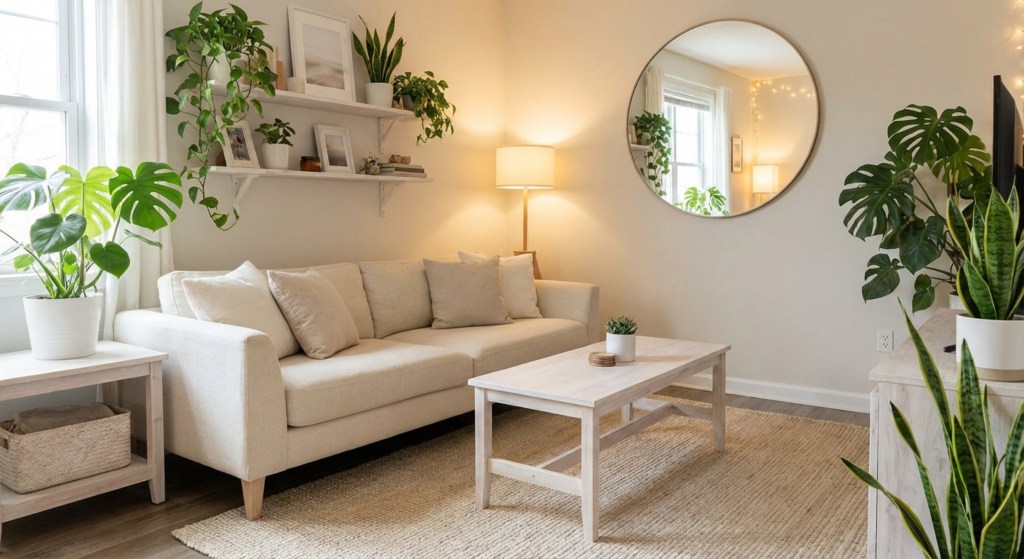
Table of Contents
Small living room decorating ideas on a budget should start with the room you already have: where you sit, how you walk through it, and what keeps landing on the floor. Keep useful furniture while you test a better arrangement. Then spend on the problem that remains, rather than buying a coordinated collection and hoping it fits.
This guide takes that approach through awkward doorways, narrow seating areas, shared work corners, and rental restrictions. The decorating suggestions are choices to try in your own room, not promises about how much larger it will look or how little a makeover will cost.
This article contains affiliate links. We may earn a commission if you buy through the Best Choice Products link below.
Small living room decorating ideas on a budget: start with the problem
Write down what bothers you in ordinary language. Perhaps guests put drinks on the floor, the sofa faces a glare-covered television, or the room becomes a laundry holding area. Those are different problems. A new rug would not be my starting point for all of them.
Separate appearance from use. If you dislike the sofa color but enjoy sitting on it, keep it in the plan and test nearby fabrics. If the sofa forces you to turn sideways at the doorway, stop shopping for cushions and reconsider its position. The object that looks dated may be less urgent than the object that interrupts your day.
Gather loose decorative items without immediately discarding them. Put aside anything you cannot place confidently, then return the pieces you actually want to see. This is a layout experiment, not a requirement to own fewer books or hide evidence that someone lives here.
Test the living room layout before buying
Follow the route from the doorway
Walk from the entrance to the sofa, window, and adjoining room as you normally would. Carry your usual bag or laundry basket. Note where furniture makes that route awkward. Try moving the side table or guest chair before assuming the sofa needs replacing.
In a narrow room, try keeping the main route along an edge of the seating area instead of through its center. In a room with doors on opposite walls, compare arrangements that leave those doors connected. Do not insist on a symmetrical layout if it puts a table where everyone wants to walk.
Arrange for the day you actually have
A television-focused household might start with comfortable viewing positions. If conversation matters more, turn seats toward each other and check whether people can hear without leaning forward. A living room that doubles as an office needs a place for the work equipment after work, not just an attractive desk in an empty photograph.
Try the proposed arrangement during an ordinary evening. Open the doors and drawers. Sit in the guest chair. Use the curtains. For a shared work corner, the site’s small-space home office layout guide is a related starting point.
Choose where the decorating budget goes
Set a spending limit you are comfortable with before comparing products. Include the costs attached to the purchase, such as delivery, assembly, hardware, and returning an unsuitable item. Keep money available for those details instead of assigning the entire budget to the photographed product.
| What happens in the room | Try with existing items | Consider buying only if needed |
|---|---|---|
| Drinks end up on the floor | Move an unused small table beside the seat | A surface that fits the available position |
| Throws cover the sofa | Assign an existing basket or cupboard | Storage sized for those actual throws |
| The seating area feels visually disconnected | Group furniture more deliberately | A rug tested against the proposed layout |
| Reading is uncomfortable in the evening | Try a lamp from another room | A lamp chosen from the seated position |
| The room feels unfinished | Edit the display and repeat an existing color | Art or textiles you specifically want |
Keep a short purchase note for each candidate: its job, where it will go, what it replaces, and the full checkout cost. If you cannot name its location, leave it off the order for now. A sale is not a layout plan.
Keep furniture that does its job
Compact furniture is useful only when it suits the people using it. A shallow sofa may suit upright conversation but disappoint someone who curls up to read. A tiny coffee table may leave the far seat without a reachable surface. Compare the actual use before favoring the smallest option.
For a replacement, record the available floor space and the delivery route. Ask the seller for the assembled and packaged dimensions rather than estimating from the room photograph. Use paper or a suitable removable marker to outline the proposed footprint, then try the room around it.
Choose multifunction furniture selectively. A storage ottoman is worth considering when you want a footrest and have blankets to put inside. If you mainly need somewhere to set drinks, compare it with an ordinary table. Do not count an ottoman as guest seating unless the manufacturer describes that use.
Secondhand shopping is a place to compare individual objects, not an automatic bargain. Ask for photographs of joins, undersides, drawers, and wear. Add transport and any work you intend to commission before deciding whether the asking price suits your budget. Keep a worn but useful table if its replacement would solve nothing.
Work with existing colors and textiles
Start your palette with the least changeable surface: flooring, a landlord’s wall color, or the sofa you plan to keep. Bring fabric samples beside it rather than choosing everything separately online. A room with a dark sofa does not have to become an all-white room to earn a small-space label.
Repeat a color you already like in a cushion cover, artwork, or curtain fabric. Compare the effect from the doorway and from the seat you use most. If you prefer strong contrast, keep it; the useful question is whether you enjoy the whole room together.
Test a rug footprint before ordering. Decide whether the rug is meant to connect the seating or simply add softness near a chair, then check it against doors and the proposed furniture positions. Do not buy a standard size because an article calls it right for most small rooms. Read the specific care instructions before choosing a textile you expect to wash.
Paint is optional, especially in a rental. If you use decorating products, follow the EPA’s household-product guidance: Use household products according to manufacturer’s directions.
The same guide says, Make sure you provide plenty of fresh air when using these products.
Treat that guidance as part of planning the job, rather than treating paint as a purely cosmetic purchase.
Check lighting and reflections from the seat
Before buying a lamp, borrow a portable lamp from elsewhere in the home and try it beside the place you read. Look at the page and toward the television. Decide whether you want light for a task, a dimmer evening atmosphere, or both. Those preferences are more useful than a compulsory lamp count.
Check the base and shade as carefully as the appearance of the fixture. An arched lamp might put its light where you want it while leaving a base exactly where you walk. Compare the actual placement, and follow the fixture’s instructions when selecting bulbs.
Try a mirror only if you like what it reflects. Look from the doorway and sofa before committing to a position. A reflection of open storage may not be the view you want. Skip the mirror if artwork would give you more pleasure; there is no need to claim a measurable brightness gain to justify either choice.
Give everyday clutter a home near where it appears
Watch what collects between tidy-ups. If charging cables and remotes live beside the sofa, assign them storage there. If paperwork comes in through the living room, give it a sorting place near that arrival point. Buying a large cabinet across the room may miss the habit you are trying to accommodate.
- Put frequently used objects where you can return them without rearranging a display.
- Test containers with the objects they will hold before choosing matching sets.
- Keep a display shelf for objects you want visible, rather than using every shelf as overflow.
- For furniture or shelving that needs installation, check the specific instructions and obtain any required rental permission before purchase.
For related decisions about closed storage and seating, see minimalist living room furniture ideas. A small room can contain hobbies, family photographs, and colorful books; storage should support those interests rather than erase them.
Finish without another shopping cycle
Choose decorative additions because you enjoy them. A plant can be part of that choice, but not an air-cleaning promise. The EPA’s indoor air guide states: There is currently no evidence, however, that a reasonable number of houseplants remove significant quantities of pollutants in homes and offices.
Leave the plant off your list if you do not want another thing to care for.
If you want to browse, retailer catalogues include Amazon, Wayfair, and Home Depot. The Best Choice Products affiliate link is another browsing option, not a tested product recommendation.
Common budget decorating questions
Should I replace the sofa first?
Only if it is the problem you need to solve. Test the layout and your comfort with the current sofa first. If its appearance bothers you more than its function, try fabric samples nearby before committing to replacement upholstery or furniture.
What should I change in a rental?
Start with movable furniture, textiles, and your own art. Check the lease and ask about changes that need permission. Choose a plan that makes sense for your expected move as well as for this room.
When is the room finished?
Stop when the recurring problems on your original list have workable answers. Keep a note of anything still awkward after normal use. Your next purchase can wait until that note names a real job.
Get the 4casahome digest
Honest reviews and no-hype guides — straight to your inbox. No spam, unsubscribe anytime.
Some links in our articles are affiliate links. See our full Affiliate Disclosure for details.

Join the conversation