Table of Contents
title: “How to Make a Room Look Expensive Cheap: Brilliant Designer Secrets 2026”
slug: “how-to-make-a-room-look-expensive-cheap”
domain: “4casahome.com”
primary_keyword: “how to make a room look expensive cheap”
meta_description: “Learn 12 designer tricks to make any room look expensive on a budget — curtains, lighting, rugs, hardware, and more. No renovation needed.”
date: 2026-07-03
word_count: 2720
status: draft
author: “Lisa Morgan”
schema:
– Article
– FAQPage
– Author
Disclosure: This article contains affiliate links. When you purchase through links on this page, we may earn a small commission at no extra cost to you.
How to Make a Room Look Expensive Cheap: Brilliant Designer Secrets 2026
Your room can look like a designer styled it without touching your savings account. The difference between a space that reads “put together” and one that reads “high-end” comes down to a handful of specific choices, not a big budget. Here are 12 concrete tips that work in any room, whether you rent or own.
Lighting and Window Treatments

Good light is the first thing designers fix. Windows and light sources shape how every other element in the room reads.
Hang Curtains From Ceiling to Floor
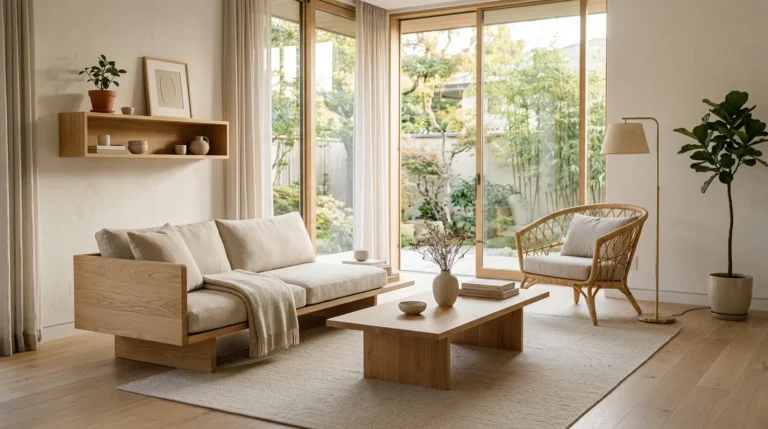
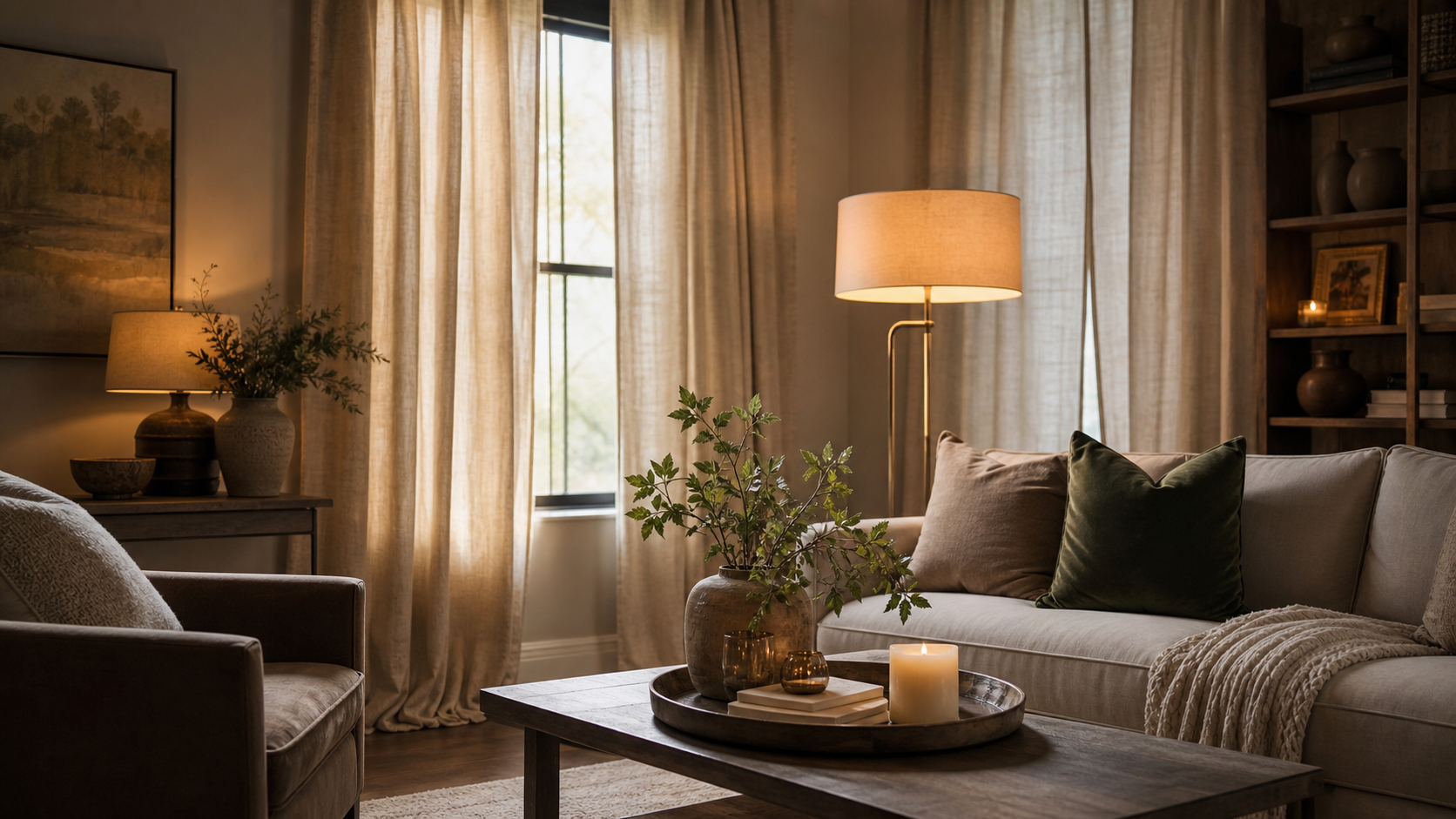
Floor-to-ceiling curtains are the single highest-impact change you can make in a room. Hanging them close to the ceiling draws the eye upward, makes ceilings feel taller, and gives every window a custom, tailored look.
The rule is simple: the rod goes 4 to 6 inches above the window frame, or close to the ceiling molding. The curtain hem should graze the floor or pool slightly. This is what designers do in every project, regardless of budget.
You do not need expensive fabric. A simple linen-look or velvet panel from Amazon in a neutral tone will read as custom when hung correctly. Look for panels that are 96 or 108 inches long to reach from a ceiling-height rod to the floor.
For step-by-step rod placement, see our guide on how to hang curtains correctly.
Product to shop: Search “96 inch curtain panels linen” on Amazon for budget-friendly options starting around $25 per panel.
Renter note: Tension rods or removable adhesive hooks work for lightweight panels and leave no holes.
Use Layered Lighting Instead of Overhead Light
The overhead ceiling light is what makes most rooms look flat and cheap. Designers almost never rely on a single overhead source. They layer three types: ambient (general), task (functional), and accent (decorative).
The budget approach: add a floor lamp in a dark corner, a table lamp on a side table, and warm-toned bulbs (2700K to 3000K) in any existing fixtures. This alone transforms the mood of a room at night.
A statement floor lamp does not need to cost $300. A well-proportioned lamp with a fabric shade in a neutral color does the same visual work. Browse our picks in the budget floor lamps review or search Amazon’s lamp section for options starting under $50.
Product to shop: Search “arc floor lamp with linen shade” on Amazon for a sculptural silhouette that reads expensive.
Swap your bulbs too: Warm white LED bulbs 2700K on Amazon cost around $10 for a pack of 6 and change the feel of a room more than most people expect.
Textiles and Rugs

Texture is how expensive rooms create depth. The trick is layering materials, not spending more per item.
Add a Large Area Rug (and Size It Correctly)
Small rugs are one of the most common mistakes in budget decorating. A rug that is too small makes furniture float and the room look smaller. A correctly sized rug grounds the space and makes it look intentional.
The rule for living rooms: the front legs of every major piece of furniture should sit on the rug. For bedrooms, the rug should extend at least 18 inches beyond the sides of the bed. When in doubt, go bigger.
Large rugs on a budget are possible. An 8×10 washable rug on Amazon starts around $80 to $120. Look for low-pile options in neutral tones (cream, warm gray, sand) as they photograph well and age gracefully. Our best area rugs under $100 roundup covers the top-rated options by room size.
Product to shop: Washable area rugs 8×10 on Amazon. Search by color in Amazon’s home section for direct price comparisons.
Layer Textiles for Texture and Depth
Expensive-looking rooms rely on texture, not just color. The trick is mixing at least three different materials in the same palette: something smooth (velvet, cotton), something nubby (boucle, linen), and something loose (a chunky knit throw).
On a sofa or bed, this might look like: a velvet cushion cover, a linen euro sham, and a waffle-weave throw blanket. None of these need to cost more than $20 to $30 each.
Stick to a tight color range of two to three tones. Mixing textures in the same color family reads as deliberate and styled. Mixing both textures AND colors randomly reads as accidental.
Products to shop on Amazon:
– Velvet cushion covers (18×18 inch, set of 2 from $12)
– Boucle throw blanket (from $25)
– Linen euro pillow shams (set of 2 from $18)
Upgrade Your Throw Pillows to Odd Numbers
Even numbers of identical pillows read as “hotel basic.” Designers use odd numbers in varying sizes. On a sofa, a common arrangement is: two 22-inch pillows at each end, one 18-inch pillow in the middle in a different texture.
The covers matter more than the inserts. Buy quality pillow inserts once (feather-down or a dense poly-fill) and swap covers seasonally. A good insert holds its shape and makes any cover look more expensive.
Product to shop on Amazon:
– Pillow inserts 18×18 inch, from $10 each
– Velvet pillow covers variety set, from $20 for a set of 4
Hardware, Fixtures, and Paint

Small hardware upgrades and strategic paint use have the highest return on investment per dollar spent.
Swap Hardware for Brushed Brass or Matte Black
Cabinet pulls, drawer handles, and door knobs are the jewelry of a room. Original builder hardware is almost always basic chrome or worn brass from the 1990s, and it drags the whole space down.
Replacing hardware takes about 20 minutes per piece with a screwdriver. A full set of 10 cabinet pulls in brushed brass runs $20 to $40 on Amazon. The visual return is disproportionate to the cost.
Current 2026 finishes that read as high-end: brushed warm brass, unlacquered brass, satin nickel, and matte black. Avoid shiny chrome and bright gold unless you are working in a maximalist style intentionally.
Product to shop: Cabinet pulls in brushed brass on Amazon, typically $3 to $5 per pull for a quality ceramic or solid metal option.
Renter note: Keep the original hardware in a labeled bag to reinstall when you leave.
Paint an Accent Wall or Use Bold Color Strategically
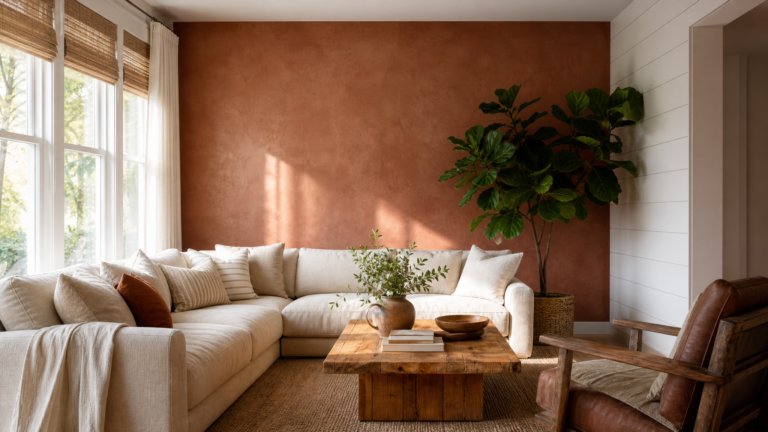
Paint is the highest return-on-investment material in any room. A single accent wall in a deep tone or a trending 2026 shade like warm clay or off-white bone transforms a room for under $40.
You do not need to paint all four walls to get a result. Painting the wall behind a sofa, a bed’s headboard wall, or the interior of a bookcase creates a focal point and makes the room feel designed.
For renters, peel-and-stick paint samples are available at most major hardware stores and on Amazon. They offer a low-commitment way to test color before committing. Standard paint is usually permitted in most leases with a white repaint on exit.
Product to shop: Small-room paint sample sets on Amazon let you test 4 to 6 colors before committing. Brands like Rust-Oleum and Kilz are available with Prime shipping.
Art, Mirrors, and Shelves
What goes on your walls and surfaces signals style more than the furniture itself.
Create a Focal Point With Mirrors
A large mirror serves two functions: it bounces natural light deeper into the room, and it creates a visual anchor on a blank wall. Both effects make a room feel bigger and more finished.
You do not need an antique or a designer piece. A plain round or arched mirror in a simple frame works well. The key is going large: a mirror under 24 inches rarely has enough presence on a wall. Go for 36 inches or bigger whenever possible.
In 2026, arched mirrors and grouped mirror clusters are both strong choices for making a wall feel styled without art or shelving (Homes & Gardens, 2026).
Product to shop: Large arched mirror on Amazon, from $35 for a frameless or simple-frame option in 36-inch and up sizes.
Renter note: Command strips rated for mirrors handle mirrors up to 20 lbs. Larger pieces need a wall anchor, which most landlords allow if patched on exit.
Style Shelves With Height, Negative Space, and Books
Open shelves are either one of the best features in a room or the most chaotic, depending on how they are styled. Expensive-looking shelves follow three rules: vary the height of objects, leave intentional negative space, and anchor with books.
Books add color, texture, and cultural context. Face some spines outward and stack others horizontally to vary the rhythm. Group by color or tone for a more curated look. Lean a small framed print against the back of the shelf for depth.
Products to shop on Amazon:
– Decorative bookends in brass or stone, from $14
– Small ceramic vase set for shelf vignettes, from $16
Frame Art Without Buying Art
Artwork changes the entire register of a room. But original art is expensive. The solution: frame things that are not traditional art.
Options that work well: printed pages from a vintage botanical book, a scanned vintage map from a public domain archive, pages from a designer coffee table book, or free high-resolution downloads from sources like Unsplash or The Metropolitan Museum of Art’s open access collection (The Met, open access).
A consistent frame style across multiple pieces creates a gallery wall that reads as intentional. Simple black, white, or natural wood frames in matching sizes are the most flexible.
Product to shop on Amazon:
– Gallery wall frame set, from $28 for a set of 5 or 6 matching frames in black or natural wood
– Matted picture frames 8×10, from $18 for a set of 4
Plants, Greenery, and Editing
The final layer of a designed room is organic: plants, negative space, and editing down to only what earns its place.
Add Greenery: Real or High-Quality Faux
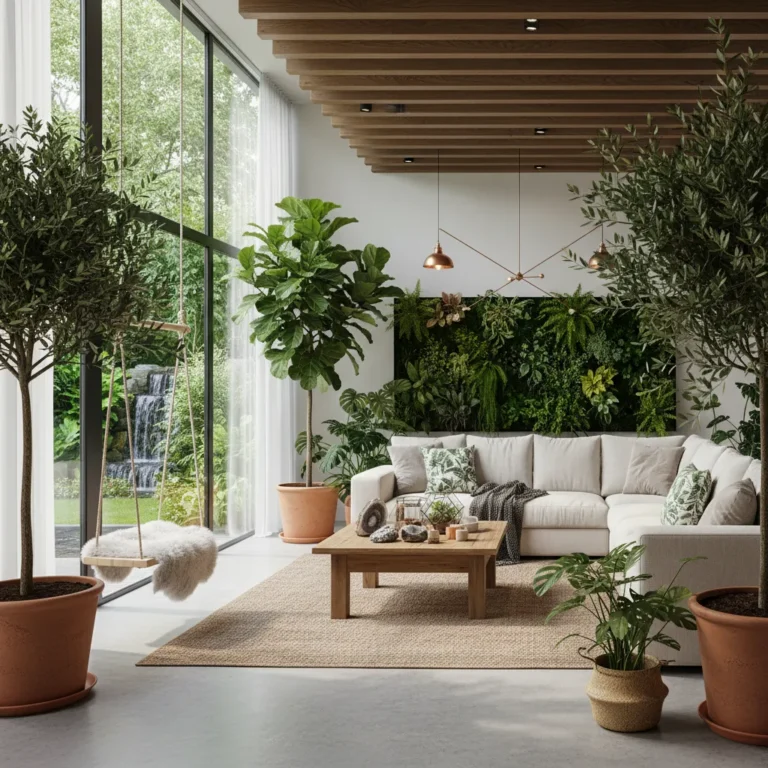
A well-placed plant changes the energy of a room in a way that objects cannot. Plants add organic scale, texture, and a sense of life. A large potted plant in a corner can fill negative space the way a piece of furniture would, at a fraction of the cost.
If you cannot commit to live plants, high-quality faux stems in 2026 are dramatically better than five years ago. Look for textured leaves (olive branches, eucalyptus, monstera) in realistic matte finishes rather than shiny plastic-looking options.
Real options to consider: a pothos or snake plant is nearly impossible to kill and grows in low light. A fiddle-leaf fig or a tall bird of paradise works as a room anchor in a bright corner.
Product to shop on Amazon:
– Faux olive tree large, from $45 for a 4-foot option
– Realistic faux eucalyptus stems, from $12 for a bundle of 10
Edit and Declutter (This Costs Nothing)
Clutter makes even beautiful objects look cheap. The fastest and most affordable change in this guide is editing what is already in your room.
The designer approach: remove everything from surfaces. Then add back only what earns its place. Keep three objects or fewer on any single surface, and group them in odd numbers with varying heights.
One tall item (a vase, a candlestick), one medium item (a small plant, a book stack), and one low item (a decorative object, a coaster) create the kind of vignette you see in interior photography. This works on side tables, coffee tables, kitchen counters, and shelves.
Best Pick: Shop Your Entire Affordable Upgrade on Amazon
For a full room refresh using the 12 tips above, Amazon is the most practical starting point. You can compare prices, check reviews on specific dimensions and fabric quality, and receive everything quickly with Prime. A complete room-level upgrade covering curtains, a rug, throw pillows, a mirror, and a floor lamp typically lands between $150 and $350 at Amazon’s price points.
Start with the changes that have the highest visual impact per dollar: curtain height and length, lighting layers, and a correctly sized rug. Those three changes alone will shift how the room reads before you spend on anything else.
Shop the full budget decor collection on Amazon
About the Author
Lisa Morgan is an interior designer and home stylist with over 12 years of experience working with clients across the US and UK on budget-conscious room transformations. She has contributed to shelter publications and consults on affordable luxury staging for real estate clients. At 4casahome.com, Lisa focuses on practical, actionable advice for renters and first-time homeowners who want a high-end look without renovation-level budgets. Her philosophy: proportion and editing outperform spending every time.
Frequently Asked Questions
How do I make a cheap room look expensive?
Focus on three things first: hang curtains ceiling-to-floor, swap overhead lighting for layered lamps, and size your rug correctly so furniture legs rest on it. These three changes produce the largest visible difference for the smallest spend, usually under $150 combined when shopping at budget retailers.
What makes a room look expensive on a budget?
Consistency of style, correct proportions, and edited surfaces. A room with matching frame styles, a cohesive color palette across textiles, and clear negative space on every surface reads as expensive even with budget furniture. Clutter and mismatched scales are the primary signals of a low-budget room.
How do I make my living room look more expensive without spending money?
Edit the room first. Remove items from surfaces until you reach three or fewer per surface. Rearrange furniture so the sofa faces the room’s natural focal point (a window, a fireplace, or a TV wall). Hang existing art slightly higher than you think looks right. These changes cost nothing.
What color makes a room look expensive?
Warm neutrals like greige, warm white, clay, and soft terracotta consistently read as high-end because they photograph well and complement most furniture tones. Deep tones like forest green, navy, or warm charcoal on a single accent wall also add richness. Avoid cool gray if you want warmth. According to Homes & Gardens, warm Scandinavian-influenced tones are trending in 2026.
Do curtains make a room look expensive?
Yes, but only when hung correctly. Ceiling-to-floor panels in linen, velvet, or faux silk read as custom regardless of their actual cost. The most common mistake is hanging curtains at window frame height with short panels. Interior designers cite this as a high-impact, low-cost upgrade (Kate Watson-Smyth, Substack).
The Bottom Line
Making a room look more expensive is a skill, not a budget level. The 12 tips above work because they address what actually signals quality: proportion, texture, light, and edited styling. None of them require renovating, buying new furniture, or spending more than $50 at a time.
Start with curtains and lighting this week. Add a correctly sized rug next month. Swap hardware when you find pulls you like. Layer textiles over time. The room will shift gradually, and six months from now it will look like a completely different space.
Browse the full range of budget home decor on Amazon to find the specific products that match your room’s color palette and style.
Get the 4casahome digest
Honest reviews and no-hype guides — straight to your inbox. No spam, unsubscribe anytime.
Some links in our articles are affiliate links. See our full Affiliate Disclosure for details.
Written and tested by our editorial team
4CasaHome Editorial Team
Interior Design & Smart Home Experts
All product reviews are based on hands-on testing in real home environments. Smart home content is verified by our CEDIA-certified integrator. Meet our team.