Table of Contents
Robot vacuums should be compared by the cleaning job you want to delegate and the upkeep you will accept. A dock-focused model such as Roborock S8 MaxV Ultra and a bin-swap design such as Roomba Combo j5+ represent different buying questions; neither becomes the right choice solely from a suction headline.
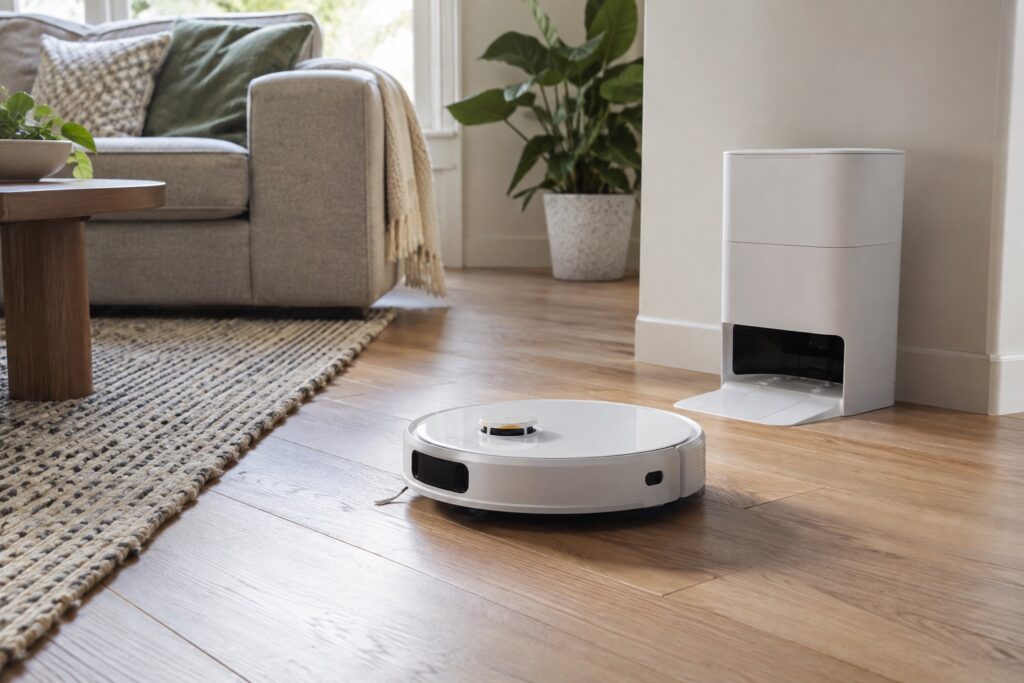
robot vacuum cleaning a wooden floor next to its self-emptying dock in a bright living room" class="wp-image-6473" decoding="async" height="1024" loading="lazy" src="https://4casahome.com/wp-content/uploads/2026/04/4casahome-5119-best-robot-vacuums-2026-tested-and-ranked-for-every-budget.jpg" width="1536"/>
How should you compare robot vacuums?
Compare robot vacuums by matching their documented cleaning arrangement to your floor plan and maintenance preferences, then check the exact model and package before considering price, rather than ranking machines by an isolated specification that does not tell you how the whole appliance will fit into your cleaning routine.
The Roborock S8 MaxV Ultra page lists automatic dust emptying and hot-water mop washing. The Roomba Combo j5+ documentation describes changing between vacuuming and vacuum-and-mop modes by swapping bins.
These are documented examples, not results from our own floor tests. We have not measured pickup, obstacle avoidance, noise or long-term reliability, so this guide offers a selection method rather than a universal winner.
| Example | Published feature | Your buying question |
|---|---|---|
| Roborock S8 MaxV Ultra | Dock-assisted emptying and mop washing | Do I have a suitable place to use and maintain the dock? |
| Roomba Combo j5+ | Bin swap for different cleaning modes | Am I happy to change the arrangement for mopping? |
What should you check about your floors?
Check the floor surfaces, rugs, thresholds and furniture access in the rooms you want cleaned, then compare those details with the manufacturer’s instructions for the exact machine, because a robot should be selected for the route it can use in your home rather than the room shown in a product photograph.
Draw a simple plan of the intended cleaning area. Mark the places where you normally move chairs, keep pet bowls or leave shoes. Include rooms you want excluded rather than assuming the machine should enter every open doorway.
Check the floor maker’s care instructions before considering a wet-cleaning routine. If the guidance is unclear, get an answer from the floor manufacturer instead of assuming that a robot’s water controls make every surface suitable.
Measure the spaces the machine would need to enter and compare them with its actual dimensions. Include furniture clearance and the access needed to retrieve the robot if it stops somewhere inconvenient.
Our robot-vacuum selection guide provides another way to organize these checks without choosing on a single advertised number.
Where should you plan to put the dock?
Plan the dock location by checking the manufacturer’s clearance requirements, access to the machine and the owner tasks associated with the selected package, so you can use and maintain the appliance without squeezing it into an attractive but impractical gap or assuming every dock version has the same installation requirements.
Look at the proposed location as a working area, not only a parking place. Ask whether you can reach the parts the manual says to inspect, remove or refill. If furniture must be moved each time, consider a different location before purchase.
Read the package name carefully. Confirm which dock is supplied and what the installation instructions require for that version. Do not infer plumbing requirements from another listing with a similar product name.
Ask yourself where cleaning supplies and replacement parts will live. A reasonable arrangement should let you carry out the required jobs without leaving bags, cloths or tanks scattered across the room.
If space is tight, our small-space storage ideas can help you plan a practical place for supporting supplies while keeping the dock’s required access clear.
What should pet owners look at beyond marketing?
Pet owners should look at the preparation and maintenance the manufacturer expects, the features documented for the exact model and the household’s own tolerance for interruptions, rather than interpreting pet-friendly wording or an obstacle-recognition claim as permission to leave every toy, bowl or possible accident in the cleaning area.
List the situations that actually occur at home. Long hair, food near bowls, toys left under chairs and animals that are uneasy around moving equipment create different questions. Ask which instructions and exclusions apply to your intended use.
Do not test obstacle-recognition claims by exposing the machine to an avoidable mess. Read the manufacturer’s stated conditions and keep a plan for inspecting the cleaning area before a run.
Check the brush-cleaning and inspection instructions before choosing a model. If that work is something you will struggle to perform, look for a design whose maintenance process you can manage or a seller that can demonstrate it.
Our pet-hair robot-vacuum guide can help frame further questions, but it should not replace the exact model’s care instructions or its stated limitations.
How do you decide whether mopping is worth it?
Decide whether mopping is worth it by comparing the preparation, floor restrictions and owner involvement of the specific design with the cleaning routine you already use, because adding a mop function only helps your household if you are willing to carry out the associated setup and maintenance instead of avoiding them.
Use the manufacturer’s description to write down how a mopping session begins and ends. Include any bin or pad change, preparation of the cleaning area and the tasks required after use.
For the Roomba Combo j5+, iRobot’s stated bin-swap approach makes that mode change an explicit purchase consideration. Do not treat it as the same process as an appliance whose dock handles parts of mop upkeep.
For a dock-equipped model, read the cleaning and care sections as closely as the automation features. Choose only if you have a suitable place to perform the remaining owner tasks and use the prescribed consumables.
A vacuum-only routine may be the more suitable purchase if you do not want the wet-cleaning arrangement. That is a preference decision, not a claim that every household needs the most elaborate available model.
What should you verify before ordering?
Before ordering, verify the exact model, dock package, replacement-part route and return conditions against the cleaning plan you have written, so the purchase remains grounded in your own space and maintenance capacity rather than a temporary discount, an unverified review score or an unsupported promise of completely hands-free cleaning.
Keep the comparison narrow enough to make a decision. For each candidate, note the cleaning arrangement, required preparation and expected owner tasks using its manual. If the model names are confusing, ask the manufacturer or retailer for the exact product identifier.
- Confirm the included machine and dock.
- Check the floor and location instructions.
- Read cleaning and maintenance requirements.
- Find the relevant replacement parts.
- Compare the seller’s return conditions.
- Plan a supervised initial setup using the manual.
For integration with other equipment, see our smart-home compatibility guide. Keep cleaning needs ahead of voice-control preferences.
There is no ownership-cost estimate here because consumable prices, usage and local electricity charges were not independently assessed. Ask for the information you need rather than borrowing a generic annual figure from a different model.
FAQ
For a robot-vacuum purchase, keep cleaning design, package details and initial setup questions separate from promotional performance claims, so you can choose an appliance you know how to accommodate and maintain without assuming that every dock works alike or that a single specification establishes an overall winner.
Should I choose the highest suction rating?
Not as the sole selection rule. Compare the complete cleaning arrangement and your floor requirements before deciding whether a specification should influence the shortlist.
Can I assume every dock needs plumbing?
No: read the instructions for the exact package you are considering. If listings offer different dock versions, ask which one is included before ordering.
Do you have independent test results for these examples?
No. The comparison uses manufacturer documentation and separates published features from the household decisions they raise.
What should I do before the first run?
Follow the manufacturer’s setup and floor-preparation instructions. Make time to observe the initial operation and check the intended cleaning area rather than leaving an unfamiliar arrangement unattended immediately.
Get the 4casahome digest
Honest reviews and no-hype guides — straight to your inbox. No spam, unsubscribe anytime.
Some links in our articles are affiliate links. See our full Affiliate Disclosure for details.


Join the conversation